
Standing Desks and Height Adjustable Desks
What are the benefits of standing desks?
|
Standing desks have many benefits. In fact, unless you have an injury that may prevent you from standing, there are not really any negatives associated with using a standing desk at work (or at home for that matter).
Sitting is an extremely easy task for us to do. And yet we still succumb to injuries as a result of too much sitting. The majority of these ergonomic injuries are accumulative in nature. This means that they are the result of a lot of small stresses accumulating over time. This is essentially the definition of a repeated-stress-injury (or RSI). |
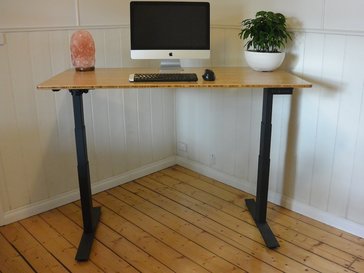
Standing Desks / Height Adjustable Desks
|
With this in mind, the number one reason that standing desks can help to prevent ergonomic injuries are that they allow you to interrupt this accumulation of stress in a particular area. Switching between sitting and standing throughout the day ensures that stresses that you place on the body vary, and that the same areas of the body are not always under the same stress. If these small stresses are not continuously accumulating throughout the day, they are less likely to develop into larger stresses and eventually injuries.
Another advantage to standing desks over sitting desks is the increased freedom of movement you have when you're standing. An example best explains this. If you're sitting and you need to reach for a item just out of reach, you typically lean forwards excessively from the lower back. However, if you're standing, instead of leaning forwards excessively, you can simply move your entire body closer to whatever it is your trying to reach for. This ability to move more freely when standing reduces the risk of injury and pain considerably.
Another consideration is the general negative impact constant sitting has on your body. Prolonged sitting causes considerable deconditioning to your core musculature and the muscles responsible for maintaining a good posture. This is simply because when you sit, you don't need to use these muscles. So the age old adage of "use it or lose it" certainly applies here. This deconditioning isn't likely to cause an injury whilst you are sitting, because as was just stated, you don't need these muscles when you sit. However, what it is likely to do, is increase your risk of injury when you do actually require these muscles to do some work (i.e when you're doing something physical), because they will now be much weaker and may be unable to handle the load required of them.
It should be noted however that just because you sit for prolonged periods, this doesn't automatically mean that you will sustain an ergonomic injury, or sustain an injury when you're performing a physical task, due to the deconditioning caused by prolonged sitting. It is important to remember this. However, there can be no denying that reducing the amount of prolonged sitting does lower your chances of sustaining one of these injuries because (1) you're reducing the accumulation of repetitive stresses, and (2) you're reducing the amount of deconditioning your body undergoes.
Outside of the three medical/scientific reasons why standing desks are beneficial discussed above, there is a simple evolutionary consideration as well. Humans are simply not designed to sit for prolonged periods - at least not on a repetitive basis. We are bipedal animals. We evolved from quadrupeds (on four legs) to be upright and standing on two legs. This evolution took us millions of years to achieve. Ironically, it has seemingly only taken us one generation to forget what took us millions of years to learn!
Whilst standing desks are great and offer many benefits, it isn't a good idea to try to go from sitting 8-12 hours per day, to standing for 8-12 hours per day. As mentioned above, constant sitting results in deconditioning of your postural muscles. You will need these muscles when you begin standing at your standing desk. As such, it is a good idea to gradually progress yourself into more prolonged bouts of standing, over about a 6-week period. For more information on this, please contact The Ergonomic Physio.
Another advantage to standing desks over sitting desks is the increased freedom of movement you have when you're standing. An example best explains this. If you're sitting and you need to reach for a item just out of reach, you typically lean forwards excessively from the lower back. However, if you're standing, instead of leaning forwards excessively, you can simply move your entire body closer to whatever it is your trying to reach for. This ability to move more freely when standing reduces the risk of injury and pain considerably.
Another consideration is the general negative impact constant sitting has on your body. Prolonged sitting causes considerable deconditioning to your core musculature and the muscles responsible for maintaining a good posture. This is simply because when you sit, you don't need to use these muscles. So the age old adage of "use it or lose it" certainly applies here. This deconditioning isn't likely to cause an injury whilst you are sitting, because as was just stated, you don't need these muscles when you sit. However, what it is likely to do, is increase your risk of injury when you do actually require these muscles to do some work (i.e when you're doing something physical), because they will now be much weaker and may be unable to handle the load required of them.
It should be noted however that just because you sit for prolonged periods, this doesn't automatically mean that you will sustain an ergonomic injury, or sustain an injury when you're performing a physical task, due to the deconditioning caused by prolonged sitting. It is important to remember this. However, there can be no denying that reducing the amount of prolonged sitting does lower your chances of sustaining one of these injuries because (1) you're reducing the accumulation of repetitive stresses, and (2) you're reducing the amount of deconditioning your body undergoes.
Outside of the three medical/scientific reasons why standing desks are beneficial discussed above, there is a simple evolutionary consideration as well. Humans are simply not designed to sit for prolonged periods - at least not on a repetitive basis. We are bipedal animals. We evolved from quadrupeds (on four legs) to be upright and standing on two legs. This evolution took us millions of years to achieve. Ironically, it has seemingly only taken us one generation to forget what took us millions of years to learn!
Whilst standing desks are great and offer many benefits, it isn't a good idea to try to go from sitting 8-12 hours per day, to standing for 8-12 hours per day. As mentioned above, constant sitting results in deconditioning of your postural muscles. You will need these muscles when you begin standing at your standing desk. As such, it is a good idea to gradually progress yourself into more prolonged bouts of standing, over about a 6-week period. For more information on this, please contact The Ergonomic Physio.